

The short version: We built a hammer rig, mounted a standard IKEA base cabinet next to one of our BluePrint cabinets, and swung a 15-pound hammer at both until each one gave out. The IKEA cabinet failed after absorbing about 586 joules of impact energy across the whole test. Ours kept going past 3,500 joules — six times more — before we finally broke it by hand-throwing the hammer at it. Here’s exactly how we tested it, and what it means for your kitchen.
How Do Your Kitchen Cabinets Hold Up When Something Hits Them Hard?
Picture it: a stumble, a fall, a kid running full-speed around the island, or what we ended up calling the drunk uncle scenario — your uncle’s had one too many at the holiday party, loses his footing, and goes shoulder-first into the side of your cabinet.
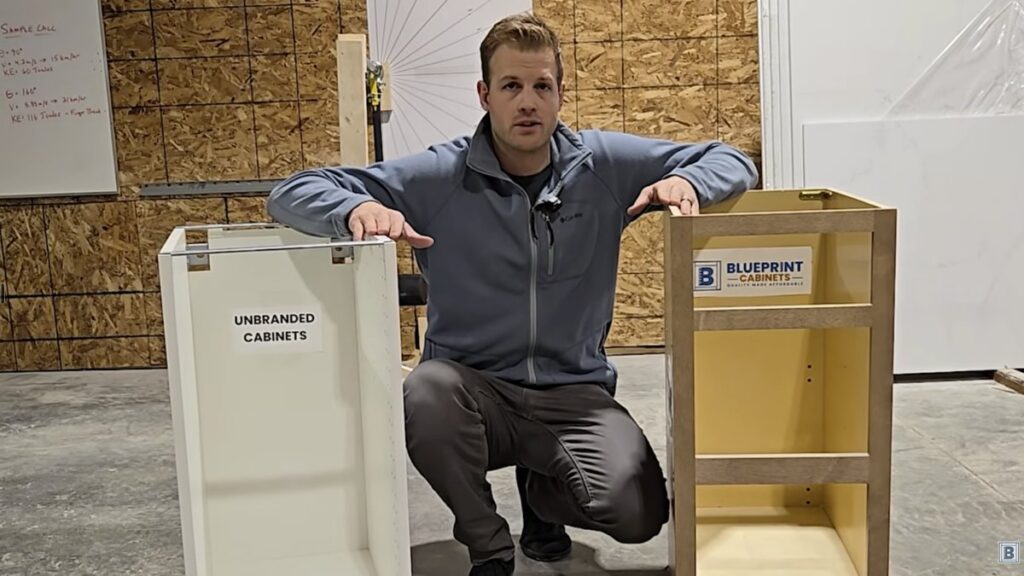
We wanted to know what actually happens, so instead of guessing, we tested it. We took a standard IKEA base cabinet and one of our own BluePrint cabinets and destroyed them both on purpose, to see which one held up and by how much.
We’re naming IKEA specifically because it’s the most recognizable example of flat-pack, particleboard cabinet construction — not to single them out unfairly. If your kitchen has particleboard RTA cabinets from a different brand, the construction is generally the same, and the physics in this post applies just as much to yours.
My background is construction, followed by a mechanical engineering degree. Patrick spent years installing kitchens and knows exactly what cabinet failure looks like out in the field. So this wasn’t just two guys swinging a hammer for the camera. We measured the speed and force behind every single hit, tracked how much total punishment each cabinet absorbed before failing, and wrote all of it down to share with you.
Here’s what we found.
The Setup: A Hammer on a Pendulum
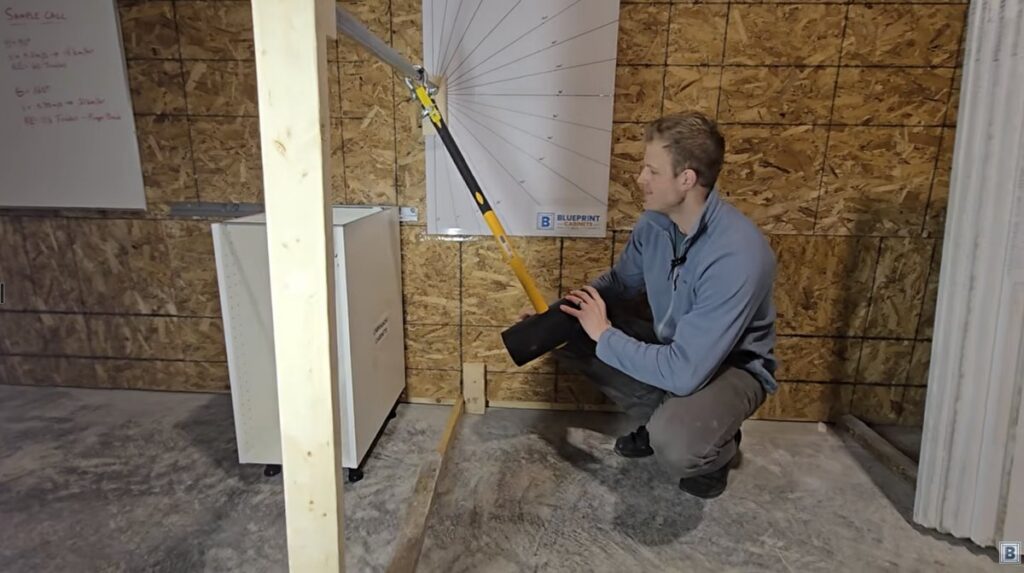
We built a simple pendulum rig in the shop: a 15-pound (6.8 kg) hammer hanging from a 3-foot (0.9 m) arm. We’d pull the hammer back to a set angle, let it go, and it would swing down and strike the face of the cabinet at the bottom of its arc. Basically a controlled wrecking ball, just cabinet-sized.
The higher we pulled the hammer back before releasing it, the harder it hit. That’s really the only physics you need to follow along.
At a 90° release (hammer pulled back to horizontal), the hammer struck at about 15 km/h and delivered 60 joules on impact — roughly what you’d spend pedalling a bike for one second. Pull it back to 160°, nearly straight overhead, and it struck at 21 km/h with 116 joules — enough force, as Lewis put it in the video, to break a finger. Ouch.
We weren’t just chasing one big hit, though. We tracked the cumulative energy each cabinet absorbed, hit after hit, all the way to failure — a closer approximation of how a cabinet actually takes damage in real life: not from one dramatic event, but from years of everyday bumps adding up.

For the curious: impact velocity works out to V = √(2gL(1−cosθ)), and kinetic energy to KE = mgL(1−cosθ), where g is gravity, L is the arm’s length, m is the hammer’s mass, and θ is the release angle. That’s the actual math behind every number in this post.
The Real Difference: What’s Actually Inside These Cabinets
Before we swung a single hammer, the two cabinets were already telling a different story — and it’s the reason the test went the way it did.
- Face frame (the visible wood frame around the front opening): ours is a solid wood face frame, tongue-and-grooved into the box and locked in with metal brackets front and back. The IKEA cabinet is frameless and uses a thin metal support bracket held on with a couple of screws.
- Back panel: ours is 5/8" plywood, thick enough to screw straight into a wall stud. The IKEA cabinet’s back is a thin fiberboard panel (you can hear it rattle if you tap it), held together mostly by a metal spanner bar that isn’t doing much structurally.
- Toe kick (the recessed base where your feet tuck under at the counter): ours is solid plywood all the way to the floor. The IKEA cabinet balances on small plastic legs — push hard enough sideways and they’ll tip.
- Box material: ours is 5/8" plywood. The IKEA cabinet uses 3/4" melamine-coated particleboard — slightly thicker on paper, but a completely different material under impact. Plywood spreads stress across layers of alternating wood grain. Particleboard cracks straight through its core and doesn’t come back.
One note on the video: the cabinet in the footage is labelled “unbranded” because at the time of shooting we weren’t sure of the implications of naming IKEA specifically. We’re comfortable naming it here — we’re stating measured facts about how the two cabinets are built and how they performed, not bashing IKEA.
None of this is a secret — it’s all sitting in both products’ specs. What the test gave us was a real number for what that difference actually costs you when something hits your cabinet hard.
Round One: The IKEA Cabinet
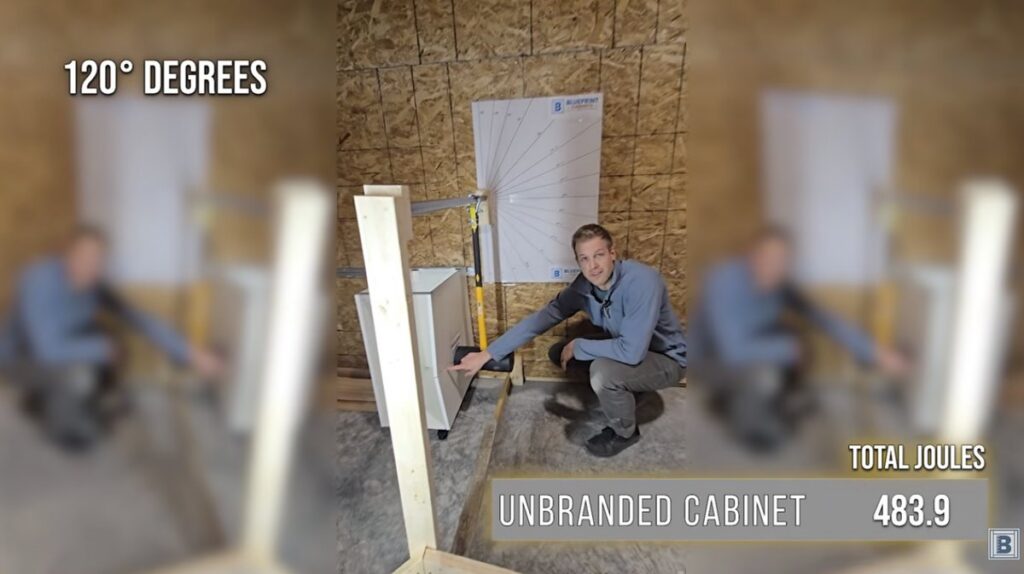
At 30°, the first problem wasn’t the cabinet cracking — it was the mounting. The cabinet moved so much on impact that we had to reinforce the wall bracing with scrap wood just to keep testing. (That extra wobble actually worked a little in the cabinet’s favour, softening some of the blow.)
From 30° to 60°, we heard cracking but couldn’t see damage yet. From 70° to 90°, it cracked on every hit, and the front corners looked ready to give.
At 100°, real damage showed up: spider-cracks spreading through the particleboard panel, a foot broken clean off, and a crack running from the side panel into the face frame.
At 120°, the cracking got serious — the whole structure was clearly compromised.
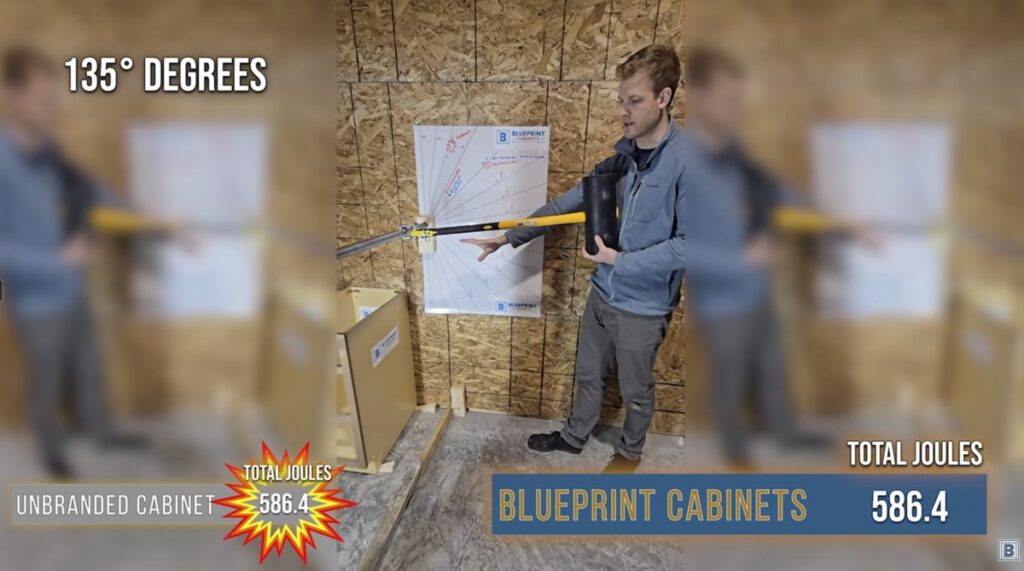
At 135°, it failed. The cabinet tore itself off the back mounting rail. One interesting detail: the screws, the thing we expected to fail first, actually held. It was the particleboard itself that gave out. One more hit for good measure, and every part of the cabinet had failed.
Total energy the IKEA cabinet absorbed before it was unusable: about 586 joules.
What Is a Joule, Anyway?
A joule is a small unit of energy — about what it takes to lift a small apple one metre off the ground, or power a tiny LED for a second. Here’s how the test numbers compare to everyday life:
Total energy absorbed before failure
The hammer test result
Particleboard (IKEA-style) cabinet
586
joules total
Failed at 135°BluePrint Cabinets
3,500+
joules total
Outlasted the testWhat does a joule feel like?
So a stumble isn’t going to destroy even a cheap cabinet outright. But a hard fall is a different story, and that’s exactly where the numbers get uncomfortable if your kitchen has IKEA-style particleboard cabinets. At the low end of a hard fall (500 J), you’re already at the failure point we measured for the IKEA cabinet. At the high end (1,400 J), you’re at nearly 2.5 times its total breaking point.
Round Two: The Cabinet From BluePrint Cabinets
The Final Tally
| Particleboard cabinet | BluePrint Cabinets | |
|---|---|---|
| Point of failure | 135° | Past 180°, plus hand-thrown hits |
| Total energy absorbed | ~586 J | 3,500+ J |
| Compared to the other cabinet | 1× (baseline) | 6.1× more |
| At a hard real-life fall (1,400 J) | Destroyed at ~43% of that | Still standing |
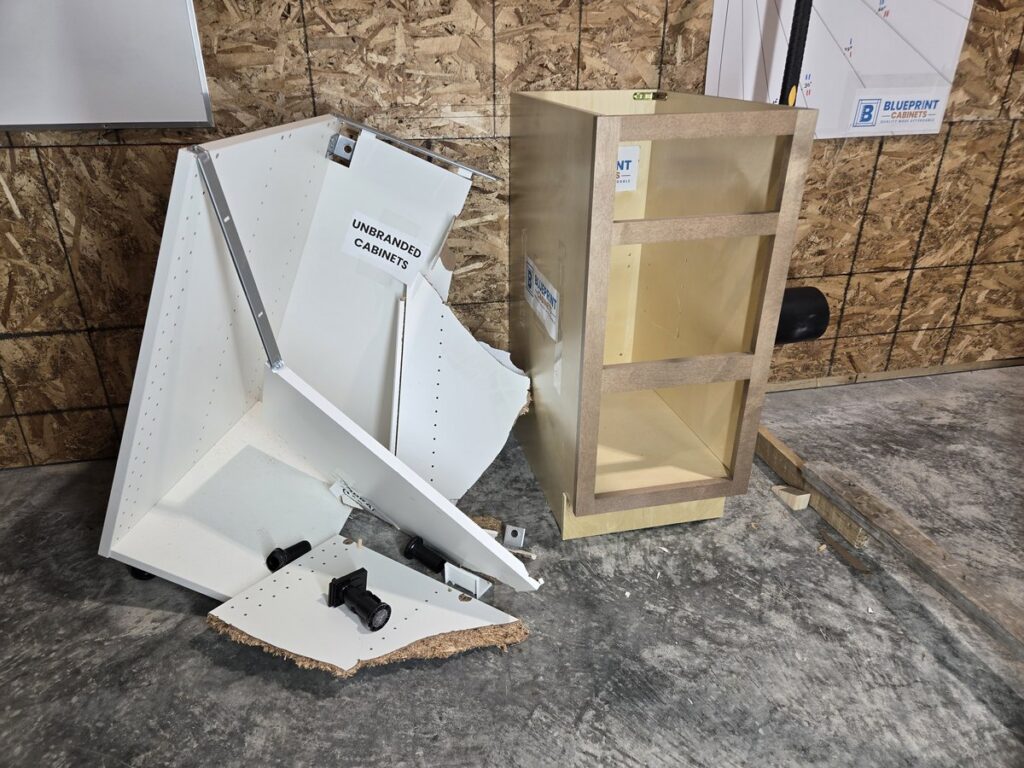
The IKEA cabinet cracked through its particleboard core — not at a screw, not at a joint, but through the material itself. That’s the nature of particleboard: it doesn’t compress and recover. It fractures once, and it’s done. You replace it.
Our plywood, glued in alternating grain layers, spreads that same stress out instead of letting it concentrate in one spot. When ours finally did start to separate, it happened at the glue lines between layers — a failure that’s visible, predictable, and in most real-world cases fixable with clamps and glue rather than a full replacement.
What This Actually Means for Your Kitchen
The difference between plywood and particleboard construction has always been sitting on the spec sheet. We chose to sell cabinets built with 5/8" plywood boxes and solid birch face frames, and we’ve always said it matters. What we didn’t have before was a number.
Now we do: six times more impact energy before failure.
Over the life of a kitchen — years of daily use, the occasional hard bump, kids, pets, parties, movers hauling things through a doorway — that difference adds up. This test was never really about surviving one big hit. It’s about whether your kitchen is still standing ten years from now.
We won’t always be the cheapest cabinets for your kitchen reno or new build, and we’re okay with that. We’ve hand-picked what we believe is the most affordable path to solid plywood construction, real birch face frames, and a kitchen built to take what real life throws at it. You can start a free design whenever you’re ready.
We’ve now got 3,500 joules of data to back that up.
Ready to Start Your Kitchen?
Free design consultation. 3D renderings included. About 2 to 4 weeks from order to delivery.
→ Get a free price estimate
→ Visit the showroom — 103 NB-105, Fredericton · Mon–Fri, 9–4, no appointment needed · 506-300-1234
→ Questions about a specific cabinet or layout? Get in touch.
BluePrint Cabinets is a locally owned company based in Fredericton, NB. We hand-pick and supply RTA kitchen, bathroom, and storage cabinetry across New Brunswick — quality made affordable.